
Est. 1852
A Lighthouse Born of Tragedy
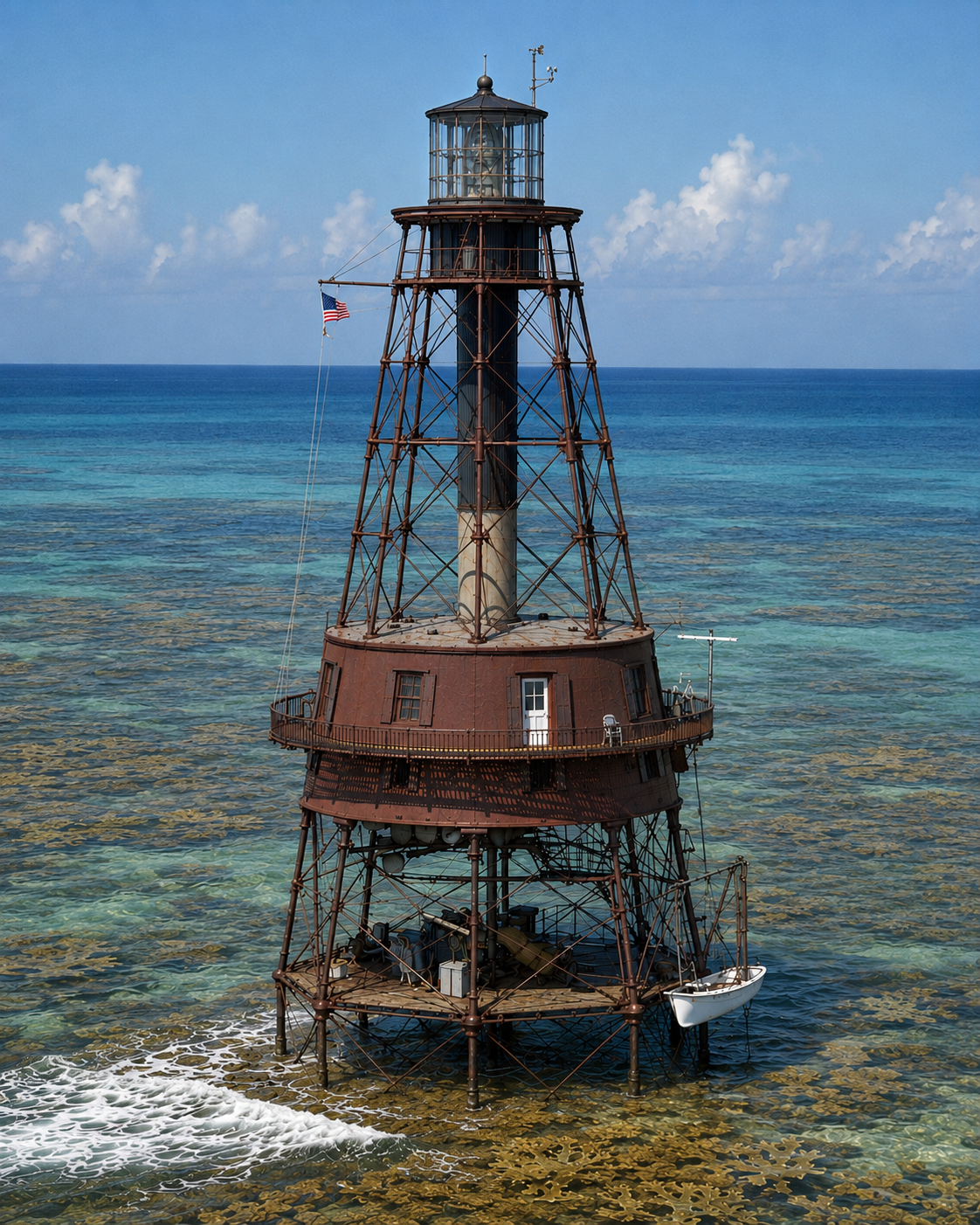
For over 170 years, Carysfort Reef Lighthouse has guided mariners through one of the most treacherous stretches of the Florida Straits.
The Most Dangerous Reef in the Florida Keys
Long before the lighthouse stood, Carysfort Reef was a graveyard for ships. The reef — a shallow, living coral formation extending from the surface of the sea — lay directly in the path of vessels navigating the Florida Straits, the narrow channel between the Keys and Cuba that served as the primary maritime highway between the Gulf of Mexico and the Atlantic.
The reef takes its name from HMS Carysfort, a British frigate that ran aground here in 1770. It was far from the last. Wrecks accumulated over the decades, and the salvage industry that grew up around them became one of the most lucrative businesses in early Florida. The town of Key West, in fact, was the wealthiest city per capita in the United States in the 1820s — built almost entirely on the proceeds of reef wrecks.
The human and economic cost of these wrecks eventually forced the hand of the federal government. Something permanent had to be built — not on land, but in the open ocean, directly on the reef itself.
1770
HMS Carysfort runs aground
Engineering the Impossible: 1848–1852
Building a lighthouse on a submerged coral reef in the open Atlantic required an entirely new approach to engineering.
Congress Authorizes Construction
After years of lobbying by maritime interests and the U.S. Life-Saving Service, Congress appropriates funds for a permanent lighthouse at Carysfort Reef.
Design Selected: Iron Screw-Pile
Army Corps of Engineers officer Lt. George Meade — later a Union general at Gettysburg — is assigned to design the structure. He adapts the British screw-pile lighthouse concept for Florida's exposed reef conditions.
Construction Begins
Workers begin driving iron screw-pile legs into the coral reef in open ocean, working from a tender vessel in often brutal conditions. The design allows storm surge to pass beneath the structure rather than topple it.
First Light
On March 10, 1852, the Carysfort Reef Lighthouse is lit for the first time. At 112 feet, it is the tallest lighthouse in Florida and one of the most sophisticated offshore structures in the world.
Lt. George Meade and the Iron Lighthouse
The man who designed Carysfort Reef Lighthouse would go on to command the Army of the Potomac at the Battle of Gettysburg. But in 1849, George Gordon Meade was a young Army engineer tasked with solving one of the most difficult construction problems of the 19th century: how to build a stable, permanent structure on a submerged coral reef in the open Atlantic.
Meade's solution was elegant. Rather than attempting to build a masonry tower on an unstable reef — as had been tried elsewhere with disastrous results — he designed an open iron framework on screw-pile legs that could be driven directly into the coral. The open lattice structure offered minimal wind resistance, and the elevated platform kept the keeper's quarters and light well above storm surge.
The design proved so successful that Meade went on to design several other Florida reef lighthouses using the same principles, including Sand Key and Sombrero Key. The Carysfort design became the template for offshore lighthouse construction in America for decades.
Meade's iron screw-pile design was not just an engineering achievement — it was a revolution in how humanity could inhabit the open sea.
The Light That Guided a Nation
From its first illumination in 1852, Carysfort Reef Lighthouse served as the primary navigational marker for the Florida Straits — one of the busiest and most strategically important maritime corridors in the Western Hemisphere. Ships carrying cotton, sugar, timber, and manufactured goods between Gulf ports and the Eastern Seaboard depended on the light to safely navigate the reef.
During the Civil War, the lighthouse took on added strategic significance. Union forces maintained the light throughout the war, using it to support the naval blockade of Confederate ports. The lighthouse keeper's logs from this period record the passage of warships, blockade runners, and refugee vessels.
Through the late 19th and early 20th centuries, the lighthouse guided the growing commercial traffic of the Caribbean trade, the fishing fleets of the Keys, and the early pleasure craft that began exploring Florida waters. The light was automated in 1960, ending the era of resident lighthouse keepers, but its navigational function continued uninterrupted.
The Definitive Record: Neil Hunley's Two-Volume History
The most comprehensive historical account of Carysfort Reef Lighthouse is found in Neil Hunley's landmark two-volume series — the product of years of archival research, oral histories, and on-site documentation.
Volume I
The Carysfort Reef Lighthouse: Construction, Keepers & the Age of Steam
Volume I covers the engineering and construction of the lighthouse, the lives of the keepers who tended it through storms and isolation, and the lighthouse's role in the maritime economy of the 19th-century Florida Keys.
- Iron screw-pile engineering
- Lt. George Meade's design
- Keeper logs and oral histories
- Wrecking industry and salvage
- Civil War strategic role
Volume II
The Carysfort Reef Lighthouse: Automation, Decline & the Fight to Preserve
Volume II documents the transition to automation in 1960, the subsequent decades of deferred maintenance, the lighthouse's listing on the National Register of Historic Places, and the ongoing preservation challenge.
- Automation and abandonment
- Structural deterioration
- National Register listing
- Preservation advocacy
- The reef ecosystem today
Neil Hunley's books are available through the Foundation and select booksellers. Proceeds support lighthouse preservation.
170 Years of History
HMS Carysfort runs aground on the reef, giving it its name.
Key West becomes the wealthiest U.S. city per capita, built on reef salvage.
First lightship stationed at Carysfort Reef — an anchored vessel with a light.
Congress authorizes construction of a permanent lighthouse.
Lt. George Meade assigned to design the structure.
Carysfort Reef Lighthouse completed and lit for the first time, March 10.
Lighthouse maintained by Union forces throughout the Civil War.
Lighthouse automated; resident keepers depart after 108 years of continuous habitation.
Listed on the National Register of Historic Places.
Florida Keys National Marine Sanctuary established, encompassing the reef.
Foundation established to advocate for preservation and public awareness.
Historical Sources & Further Reading
The following organizations maintain primary source materials, historical records, and educational resources related to Carysfort Reef Lighthouse and Florida Keys maritime history.
NOAA Office of Coast Survey
Historical nautical charts and survey records for the Florida Straits dating to the 1840s.
U.S. Coast Guard Historian's Office
Official lighthouse records, keeper logs, and Coast Guard historical archives.
National Park Service: Maritime Heritage
NPS documentation of historic lighthouses and maritime cultural resources.
Florida Keys National Marine Sanctuary
Sanctuary history, resource protection, and the maritime heritage of the Florida Keys.
John Pennekamp Coral Reef State Park
America's first undersea state park, adjacent to the sanctuary area.
Continue Reading